
Demystifying AQL: How Merfons Glass Guarantees Flawless Packaging for Global Spirits and Food Brands
Date: July 9, 2026 Categories: Packaging Guides Views: 333
When a premium distillery orders 100,000 custom whiskey bottles or a boutique wine producer locks in a massive seasonal run, their biggest underlying fear isn't delivery speed—it is structural and aesthetic inconsistency. In global glass packaging, a single micro-fissure under the collar can halt high-speed automated bottling lines, leak expensive liquid during transit, or worse, compromise consumer safety.
At Merfons Glass, we don’t believe in "randomly picking a few bottles to look at." To protect your brand's reputation and financial bottom line, we utilize a universally recognized, statistically rigorous mathematical framework: Acceptable Quality Limit (AQL), specifically benchmarked against ISO 2859-1 and ANSI/ASQ Z1.4 standards.
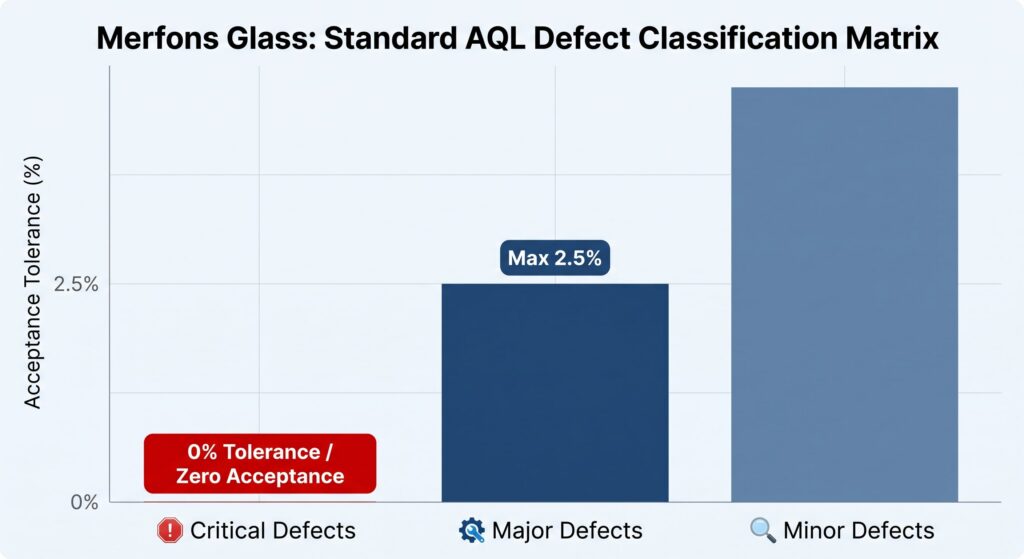
The Merfons Glass Defect Classification Matrix
Not all glass bottle imperfections are created equal. A microscopic bubble in the body of a budget vinegar container does not carry the same financial weight as a misaligned thread on a premium cognac bottle.
To create absolute clarity, Merfons Glass categorizes defects into three strict bands, applying tiered AQL levels to match:
1. Critical Defects (AQL: 0 Tolerance)
Critical defects are flaws that completely compromise safety, cause immediate product leakage, or represent legal non-compliance. At Merfons Glass, our tolerance for Critical Defects is absolute zero (0 Accept, 1 Reject).
- Examples: Flashing or split finishes (sharp glass shards inside the neck), birdswings (glass threads inside the bottle), stone inclusions creating structural stress points, and through-wall cracks.
- Action Plan: If even a single critical defect is found during an AQL audit, the entire production lot is instantly quarantined and rejected. The line is stopped for root-cause analysis.
2. Major Defects (AQL: 0.65 – 1.0)
Major defects are functional failures that do not necessarily endanger the consumer but will cause automated filling failures, capping line jams, or severe leaks.
- Examples: Out-of-tolerance neck diameters (caps cannot fit), heavily uneven wall distribution, leaning bottles (vertical axis deviation), or unlevel bottoms causing wobbling on conveyors.
- Action Plan: We apply a strict AQL 0.65 for premium spirits (e.g., bespoke Whisky and Vodka bottles) and AQL 1.0 for standard food/beverage jars. If the number of failed units exceeds the AQL mathematical limit, the lot is subjected to a 100% manual sorting loop.
3. Minor Defects (AQL: 1.5 – 2.5)
Minor defects are purely aesthetic issues. They do not impair the structural integrity or mechanical function of the container but reduce its premium visual appeal.
- Examples: Faint mold seams, superficial scuffs, minor cosmetic air bubbles, or subtle color deviations under a standard light box.
- Action Plan: We apply AQL 1.5 for ultra-premium glass art/ceramic bottles and AQL 2.5 for commercial runs.
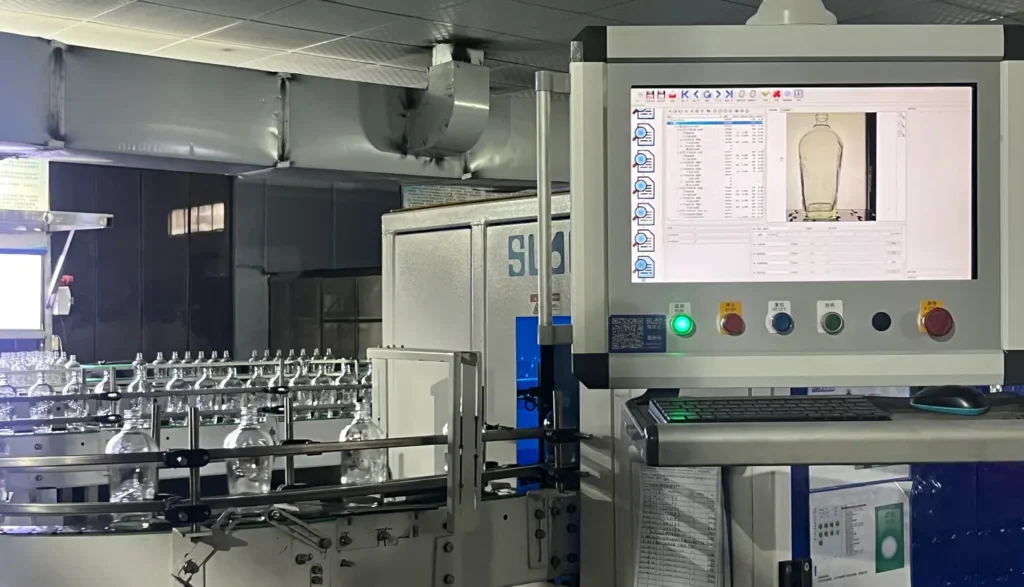
From Production to Pallet: Our 4-Stage QC Inspection Node
To ensure our AQL numbers reflect reality, Merfons Glass integrates quality inspection nodes seamlessly into the actual fabrication workflow, providing an audit trail that aligns perfectly with global compliance standards like BSCI, Sedex, and ISO 9001.
Stage 1: Cold-End Hourly Patrols (Online Inspection)
Every hour, on every active production line, a dedicated QC patrol inspector extracts 10 random bottles fresh from the annealing lehr. These units undergo rapid physical checks for weight tolerances (±3%), instantaneous height measurement, and high-intensity back-lit optical screening to spot early-stage mold wear.
Stage 2: Laboratory Stress Testing (Destructive & Mechanical)
Every shift shift change or batch transition triggers laboratory intervention. Technicians pull random subsets to put them through specialized stress equipment:
- Thermal Shock Testing: Bottles are plunged from 42∘C water directly into 0∘C water to ensure they can withstand thermal shifts during pasteurization or hot-filling.
- Internal Pressure Testing: Carbonated beverage bottles are pressurized up to 1.2 MPa to guarantee they will never burst on store shelves.
- Vertical Axis Deviation (VAD): Bottles spin on a precision rotating platform linked to dial micrometers to ensure the mouth aligns perfectly with the center of the base.
Stage 3: Final Outgoing Quality Control (OQC)
Once a batch (e.g., 100,000 units) is packed onto pallets, our final gatekeepers step in. Using General Inspection Level II metrics, they determine the exact sample size (for 100,000 units, the mathematical sample size is exactly 500 bottles).
The 500 bottles are systematically retrieved from different layers of different pallets. If Major defects stay within 10 units and Minor defects stay within 21 units, the lot is stamped "Passed for Global Export."
Stage 4: Export Packaging & Container Reinforcement
Passing the glass test means nothing if the goods break on the ocean. Merfons Glass audits packaging metrics too—ensuring premium, heavy-duty seaworthy corrugated cartons, moisture-barrier shrink wraps, and non-toxic, eco-friendly adhesive bands that comply with European and North American anti-rust and chemical customs standards.
Why Global Procurement Managers Choose Merfons Glass
Whether you are launching a luxury XO cognac in a custom crystal-clear flint bottle or scaling a craft kombucha line, our standardized statistical gatekeeping ensures that what you approved in the initial CAD prototype is exactly what arrives at your bottling facility.
Looking for a glass manufacturing partner that speaks the language of global quality compliance? Contact the Merfons Glass engineering team today to request a sample report or schedule a virtual audit of our facilities.